
Quantum Computing: The Next Frontier in Compute Evolution


Introduction: Evolution of Compute
The world of computing has undergone a massive transformation over the past few decades from the mechanical engines of Charles Babbage, to Analog forms of compute, to the evolution of the transistors, ICs, DSPs and CPUs, and eventually the Von-Neumann architecture that has dominated, and would continue to dominate the architecture of computing. However, over the past decade we have seen the rise of alternative architectures as in In-Memory and At-Memory compute, neuromorphic and Quantum computing.
Limitations of Classical Digital Compute
Von Neumann architecture performed and continues to perform well for most of the enterprise, academic and consumer use-cases, as the software ecosystem evolved around this paradigm. Moore' Law, that has held its trajectory and projections, and now evolving into Chiplet forms of SoC construction. Despite these advances and exponential growth, classic computing finds its challenges some instances. viz.,
Use Cases Challenging Digital Compute:
Cryptography (RSA key breaking)
Weather and Meteorology (climate models)
Drug discovery
Nuclear and particle physics simulations
Astronomy
The primary challenges with the Von Neumann architecture are:
Von Neumann Bottleneck: Separation of memory and processing unit and the movement of bits across that cause issues with both latency and power consumption.
Power Consumption: Scaling leads to higher energy usage.
Computational Time: Certain problems (e.g., cryptography, molecular simulations) grow exponentially with input size.
What is Quantum Computing?
Before we delve into quantum computing and Qubits, it’s worth understanding how the binary system—0s and 1s—became the backbone of digital computing.
Binary emerged due to the ease of implementation using transistors (on/off states), and storage in terms of memory Flip-Flops. While it has served us well, it imposes limits—binary logic is deterministic, sequential, and scales poorly for massively complex problems such as cryptographic key breaking or simulating quantum systems.
Quantum computing leverages principles of quantum mechanics—superposition, entanglement, and quantum interference—to perform computations in fundamentally different ways. Qubits can represent multiple states simultaneously, offering exponential scalability for certain classes of problems.
A Brief History of Quantum Computing (Timeline)
1980s: Feynman & Deutsch propose quantum systems for simulation
1994: Shor’s algorithm breaks RSA encryption theoretically
2001: IBM demonstrates 7-qubit quantum computation
2019: Google claims "quantum supremacy"
2020–2024: Rapid progress in hardware fidelity, error correction, and commercial prototypes

Technologies Enabling Quantum Computing
Quantum computing can be enabled bv various technologies, some of these started since mid-90s and we have newer technology adoption that are coming up. While, the overall technology landscape is nascent, some of these technologies do better than others with certain key KPIs (shown in subsequent sections)
Superconducting Qubits (IBM, Google)
Topological Qubits (Microsoft)
Spin Qubits (Intel)
Trapped Ions (IonQ)
Photonics (PsiQuantum)
Quantum Computing Companies – Tech & Strategy Overview

Some Key Parameters for comparison of various Quantum Technologies
Coherence time
Scalability
Error rates
Commercial readiness
Beneficiary Segments & Use Cases
Industries:
Pharmaceuticals (molecular docking, protein folding)
Finance (portfolio optimization)
Aerospace (materials simulation)
Telecom (network optimization)
Use Cases:
Secure communications (Quantum Key Distribution)
Supply chain/logistics optimization
Natural language processing
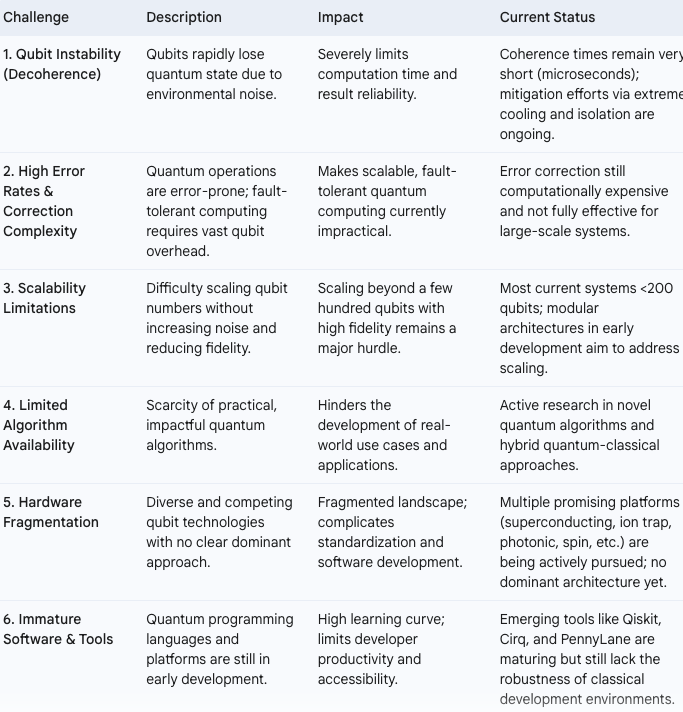
Limitations and Challenges
Here are the key challenges facing quantum computing today—technological, practical, and strategic:
Opportunities for Stakeholders
Academia: Quantum algorithms, error correction
Startups: Domain-specific quantum apps
Enterprises: PoCs in optimization, AI/ML
Consultants/Strategists: Ecosystem shaping, roadmap development
Engineers/Developers: Upskill in Qiskit, Cirq, PennyLane
European Union: Opportunity Landscape
EU Quantum Flagship: €1B initiative
Countries Active: Germany, France, Netherlands, Austria
Leading Institutions: Fraunhofer, QuTech, CNRS, IQOQI
Next Steps
Quantum computing isn’t just an evolution—it’s a revolution. While challenges remain, especially around error correction and hardware stability, and the software ecosystem the momentum is undeniable. Those who understand and act early will shape its direction.
If you would look to get on this journey to adopt Quantum Computing, or understand if and how it fits in your business, the challenges and the opportunities, the ecosystem partners that would best suit your interest and path to commercialisation.


